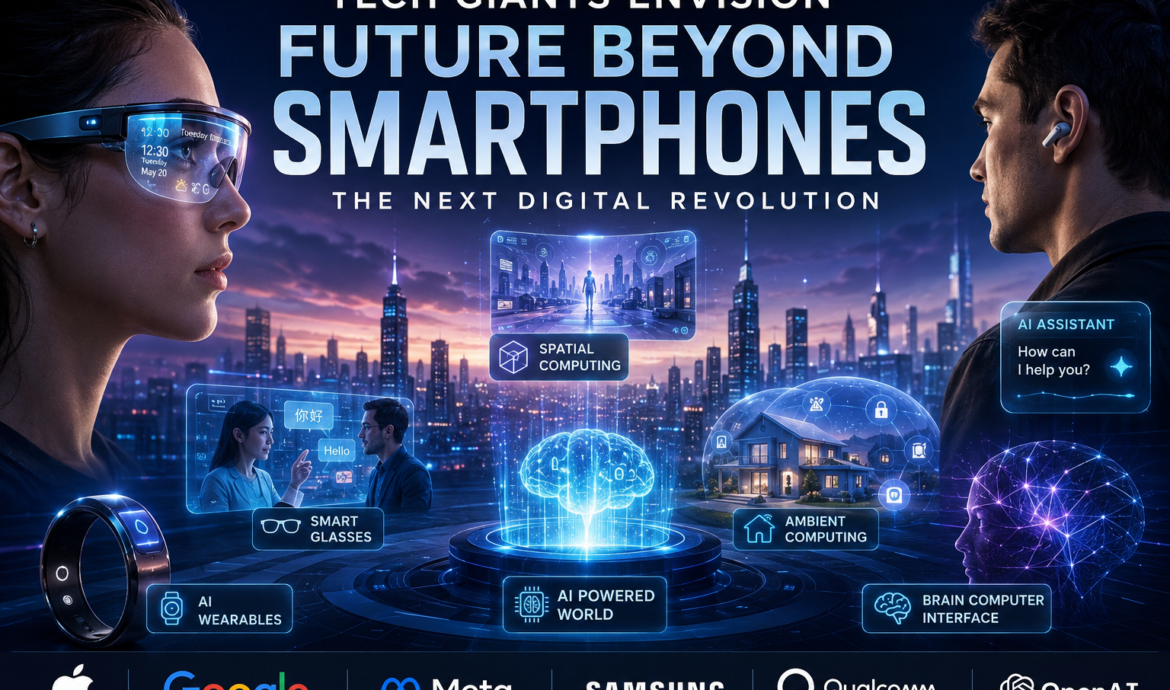
Tech Giants Envision Future Beyond Smartphones: What Comes Next?
For more than fifteen years, smartphones have been the center of modern digital life. They help us communicate, navigate, shop, work, and entertain ourselves. However, the technology industry is preparing for a major shift. Today, tech giants envision future beyond smartphones by investing billions into new forms of computing that may eventually reduce our reliance on handheld devices.
Companies such as Apple, Google, Meta, Samsung, Qualcomm, and OpenAI are developing technologies that bring digital experiences closer to everyday life. Instead of constantly looking at screens, future devices may operate through voice, gestures, augmented reality, artificial intelligence, and even brain signals.
Why tech giants envision future beyond smartphones, the technologies driving this transformation, the challenges ahead, and what consumers can expect in the coming years.
Why Smartphones Are Reaching Their Peak
The smartphone remains one of the most successful inventions in history. Yet innovation has slowed significantly.
Most modern devices already offer:
- High-performance processors
- Advanced cameras
- Fast internet connectivity
- Long battery life
- Powerful applications
As a result, consumers are upgrading less frequently. New models often provide only incremental improvements rather than revolutionary features. Industry analysts increasingly view smartphones as a mature product category.
This market maturity explains why tech giants envision future beyond smartphones and are searching for the next major computing platform.
Furthermore, artificial intelligence is changing how users interact with technology. Instead of opening apps manually, people may soon rely on AI assistants that anticipate needs and complete tasks automatically.
Smart Glasses and Wearable Technology Leading the Shift
One of the strongest indicators that tech giants envision future beyond smartphones is the race to develop smart glasses and AI-powered wearables.
Why Smart Glasses Matter
Smart glasses aim to display information directly within a user’s field of vision. Rather than pulling out a phone, users could:
- View navigation directions
- Translate conversations instantly
- Receive notifications
- Capture photos and videos
- Access AI assistants hands-free
Meta has aggressively invested in smart glasses and wearable AI technologies. Google is also pursuing AI-enabled eyewear, while Apple continues exploring future smart-glasses initiatives.
Benefits of Wearable Computing
Wearable devices offer several advantages:
- Faster access to information
- Reduced screen dependence
- Improved mobility
- More natural interactions
- Continuous AI assistance
As hardware becomes lighter and more fashionable, wearables may become everyday accessories rather than niche gadgets.
The Rise of Spatial Computing
Another reason tech giants envision future beyond smartphones is the growing potential of spatial computing.
What Is Spatial Computing?
Spatial computing blends digital content with physical environments. Instead of interacting through a flat screen, users engage with virtual objects placed within real-world spaces.
Examples include:
- Virtual workspaces
- Immersive education
- Interactive entertainment
- 3D collaboration tools
- Advanced gaming environments
Apple popularized the concept through its spatial computing strategy, while competitors continue investing heavily in similar technologies.
How It Changes User Experiences
Imagine replacing a smartphone screen with floating digital displays that appear wherever needed.
Users could:
- Watch movies on virtual screens
- Organize multiple workspaces simultaneously
- Collaborate remotely in shared virtual environments
- Access information through eye tracking and gestures
This approach creates a more immersive relationship between humans and technology.
Ambient Computing and Invisible Technology
A major trend emerging from industry research is ambient computing.
Many experts believe tech giants envision future beyond smartphones through systems that become nearly invisible.
Understanding Ambient Computing
Ambient computing allows technology to operate in the background while remaining available when needed.
Instead of actively using devices, users interact naturally through:
- Voice commands
- Environmental sensors
- AI-driven automation
- Contextual awareness
Google has been particularly vocal about building ambient experiences where technology adapts to user needs automatically.
Real-World Applications
Future ambient systems could:
- Adjust home temperatures automatically
- Schedule meetings intelligently
- Manage travel plans
- Provide health monitoring
- Deliver proactive recommendations
As AI grows more capable, these systems may reduce the need for constant device interaction.
Artificial Intelligence as the New User Interface
Artificial intelligence may become the most important reason why tech giants envision future beyond smartphones.
From Apps to AI Agents
Today’s smartphones rely heavily on applications. Users manually open apps and perform tasks.
Future systems may work differently.
AI agents could:
- Book appointments
- Purchase products
- Plan vacations
- Manage schedules
- Answer questions instantly
Recent industry discussions suggest that AI assistants could eventually replace many traditional app interactions.
The Agentic AI Revolution
Agentic AI refers to systems capable of acting independently on behalf of users.
For example, instead of opening five separate apps to organize a business trip, an AI assistant could:
- Book flights
- Reserve hotels
- Schedule transportation
- Manage calendars
- Provide travel updates
This level of automation may fundamentally transform personal computing.
Brain-Computer Interfaces and Advanced Human Interaction
Although still in development, brain-computer interfaces represent one of the most ambitious areas where tech giants envision future beyond smartphones.
What Are Brain-Computer Interfaces?
BCIs enable direct communication between the human brain and digital systems.
Potential capabilities include:
- Controlling devices through thought
- Assisting people with disabilities
- Accelerating communication
- Enhancing productivity
- Supporting immersive virtual experiences
Several technology companies and research organizations continue investing in this field.
Long-Term Possibilities
While mainstream adoption remains years away, BCIs could eventually eliminate traditional interfaces such as keyboards, touchscreens, and even voice commands.
If successful, they could represent the ultimate evolution beyond smartphones.
Challenges Facing the Post-Smartphone Future
Despite exciting developments, several obstacles remain.
Privacy Concerns
Wearable devices collect large amounts of personal information.
Consumers worry about:
- Continuous surveillance
- Data collection
- Facial recognition
- AI decision-making
Technology companies must address these concerns to build trust.
User Adoption
Many consumers remain comfortable with smartphones.
Replacing an established technology requires:
- Clear benefits
- Affordable pricing
- Comfortable designs
- Strong ecosystems
Community discussions frequently highlight uncertainty about whether consumers truly want AI wearables.
Technical Limitations
Current challenges include:
- Battery life
- Processing power
- Display quality
- Device comfort
- Connectivity requirements
Significant innovation is still required before smartphones can be fully replaced.
Which Companies Are Leading the Post-Smartphone Race?
Several organizations are shaping this transition.
Meta
Meta continues investing heavily in:
- Smart glasses
- Augmented reality
- AI wearables
- Metaverse technologies
Recent launches demonstrate its commitment to wearable computing.
Apple
Apple focuses on:
- Spatial computing
- Extended reality
- AI integration
- Future wearable platforms
The company’s ecosystem strategy could play a major role in future adoption.
Google is emphasizing:
- Ambient computing
- AI assistants
- Smart eyewear
- Context-aware experiences
Its AI capabilities provide a strong competitive advantage.
OpenAI and Emerging Players
OpenAI’s growing interest in consumer hardware suggests AI-first devices could become increasingly important.
As competition intensifies, consumers may benefit from faster innovation and more diverse device options.
What Will Replace Smartphones First?
The most realistic answer is that smartphones will not disappear overnight.
Instead, experts expect a gradual transition.
Likely stages include:
- Smartphones remain primary devices.
- Wearables become secondary companions.
- AI agents reduce app usage.
- Smart glasses gain mainstream adoption.
- Spatial computing expands.
- Smartphones move into the background.
This evolution could take a decade or longer.
Rather than a sudden replacement, future technologies will likely complement smartphones before eventually reducing their importance.
Conclusion
The evidence increasingly suggests that tech giants envision future beyond smartphones through a combination of artificial intelligence, smart glasses, wearable devices, ambient computing, and spatial computing. Companies across the technology industry are investing enormous resources into creating more natural and immersive ways for people to interact with digital information.
While smartphones remain essential today, innovation is steadily shifting toward AI-driven experiences that require less screen time and more seamless integration into everyday life. Challenges related to privacy, adoption, affordability, and technical limitations still exist. However, the momentum behind these emerging technologies continues to grow.
Whether the future belongs to smart glasses, AI assistants, spatial computing, or entirely new inventions, one thing is clear: the next era of personal technology is already taking shape. As tech giants envision future beyond smartphones, consumers should prepare for a world where computing becomes more intelligent, wearable, and invisible than ever before.
Start following these technological trends today to better understand the digital future that is rapidly approaching.
Frequently Asked Questions (FAQs)
1. Why do tech giants envision future beyond smartphones?
Technology companies believe smartphone innovation is slowing, creating opportunities for AI wearables, smart glasses, and spatial computing platforms.
2. What technology could replace smartphones first?
Smart glasses combined with AI assistants are considered the most likely first step toward reducing smartphone dependence.
3. How does artificial intelligence support the post-smartphone era?
AI enables voice interaction, automation, contextual awareness, and digital assistants that reduce the need for traditional apps.
4. Will smartphones disappear completely?
No. Most experts expect smartphones to remain important for many years while new technologies gradually take over specific functions.
5. Which companies are investing most heavily in post-smartphone technologies?
Apple, Google, Meta, Samsung, Qualcomm, and OpenAI are among the leading organizations investing in next-generation computing platforms.
You may also like



Leave a Reply